Giving Nature a Hand: Revegetation on the Howqua
Along a gently sloping valley floor and a slow, boggy drainage line in the Howqua, a new generation of native plants is going in the ground. A piece of private property has been part of the Nature Services for Ag program, funded through the CMA, which helps landholders restore native vegetation while keeping their land productive.
Over 120 indigenous tubestock, a mix of ground flora, shrubs and trees, along with the stakes and guards needed to get them established. The plantings are designed to rebuild the layers of a healthy woodland: sedges and tussock grasses at ground level, shrubs through the middle, and eucalypts overhead as well as complementing what is already there.
The property sits within two ecological vegetation classes (EVCs) that have both been heavily affected by clearing, drainage and grazing:
Swampy Riparian Woodland (EVC 83) is a woodland of up to 15 metres that grows along low-energy streams and broad drainage lines. Swamp Gum and Manna Gum dominate the canopy, with scattered wattles and Sweet Bursaria on the levees. Moisture-loving sedges, rushes and large tussock grasses like Carex appressa and Poa labillardierei hold the soil together beneath them. Depending on the bioregion, this community is listed as Vulnerable to Endangered.
Valley Grassy Forest (EVC 47) is an open forest of up to 20 metres on fertile, gently sloping valley floors and lower hillsides. Its canopy of Yellow Box, Candlebark, Manna Gum and Narrow-leaf Peppermint stands over a dense sward of native grasses, herbs, lilies and orchids. It is listed as Vulnerable in bioregions such as the Central Victorian Uplands.
Together, these communities filter water, stabilise banks, shelter wildlife and connect habitat across the landscape.
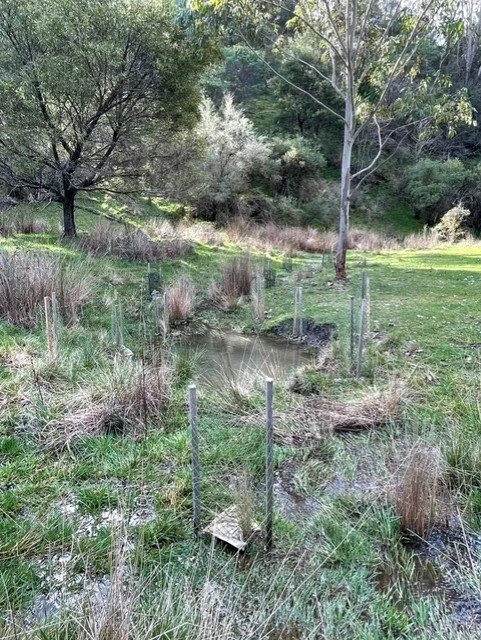
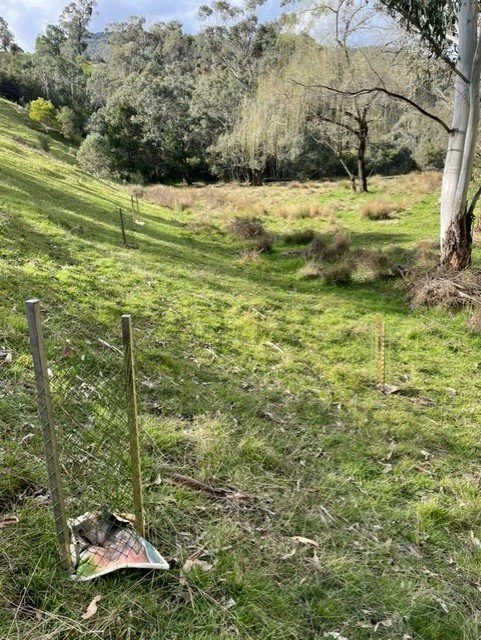
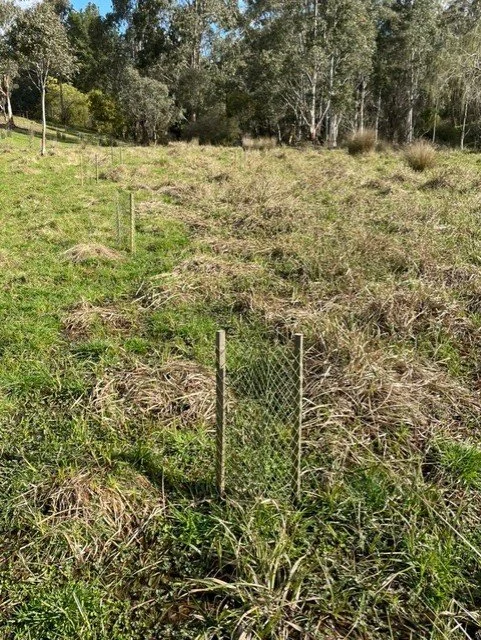
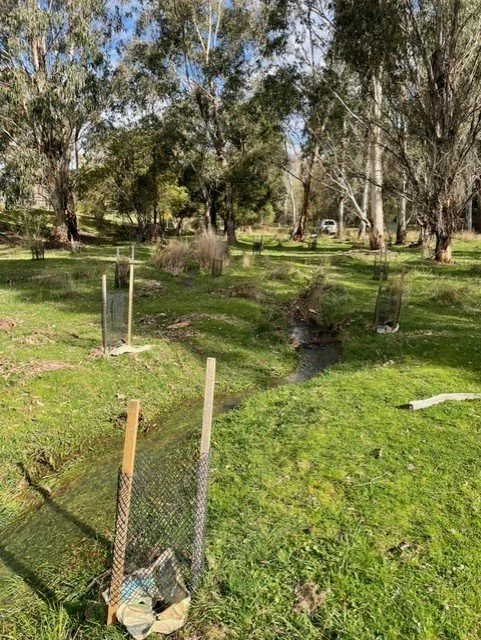
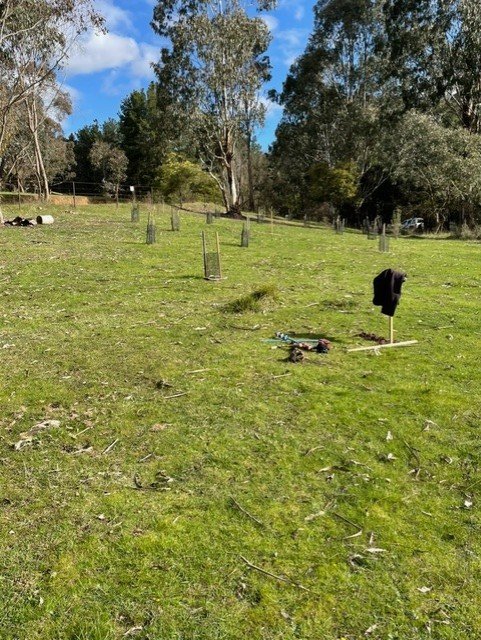
Young seedlings in the Howqua face a lot of hungry neighbours. Deer, kangaroos, rabbits, wombats and wallaboos all graze or trample new growth, so every plant has been fitted with a stake and guard. The guards are a common sight in these photos, and they give each seedling the breathing space it needs to get its roots down and its leaves above browsing height.
The images show the plantings at an early stage: guards dotted across open pasture, lines of stakes following the creek and drainage line, and tubestock set in the wetter ground where the water pools. It is quiet work now, but in a few years these small guarded plants will be the start of shaded creek banks, thick tussocks and a canopy that brings birds and other wildlife back.
Thank you to Nic for taking on this project, and to the Nature Services for Ag program and the CMA for supporting it. To learn more about the program, visit Up2Us.