DLG Wildflower walk 2026 – A walk in a genuine native garden
Article by John Gras, Delatite Landcare Group
Picture a sunny day with a group of 12 lucky wild-flower lovers tip-toeing their way through a veritable sea of wildflowers, accompanied by frequent calls of “what’s this one?” or “watch your feet” echoing across the hills. Sound far-fetched? Not so. We were in the Dungeon Gully area of Boorolite/Howqua Hills and our wildflower quest started in private property in a “herb-rich foothill” area, progressed through a narrow strip of “riparian forest” (along Dungeon Gully Creek) and ascended a ridge into a “Grassy Dry Forest” zone in the Mansfield State Forest. It’s a place where the pulse elevates, and that’s not just because of the climb, this is a favoured location for native terrestrial orchids.
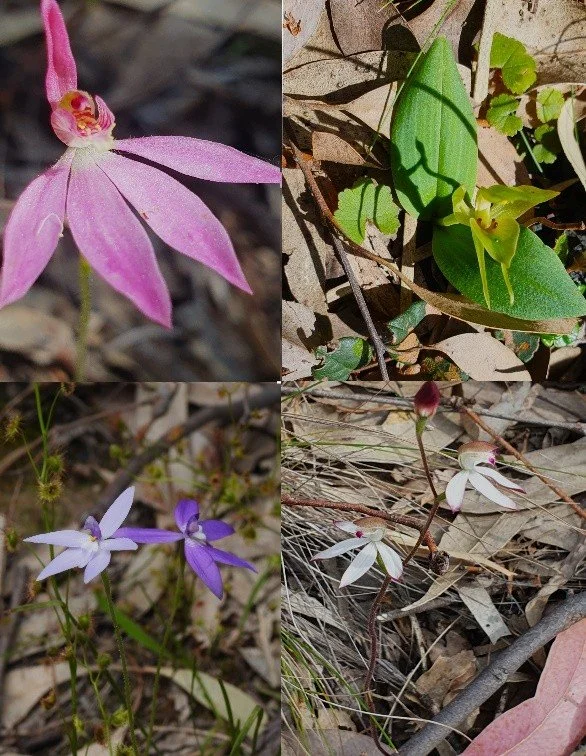
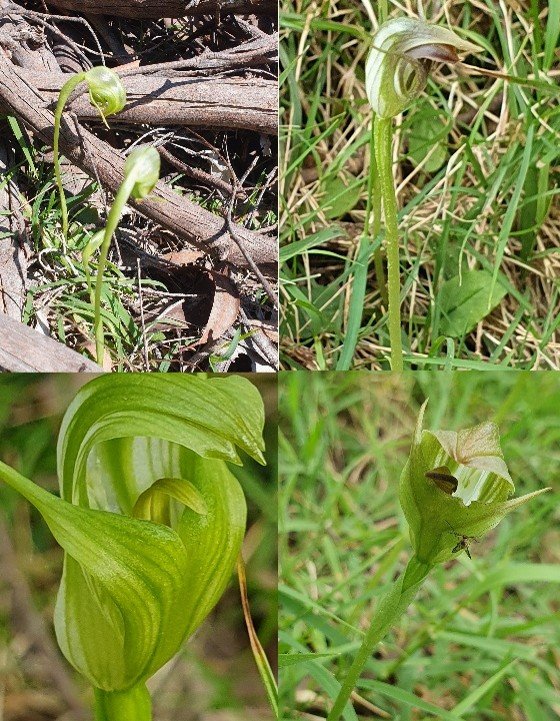
We should backtrack though to the riparian zone, near the creek where it’s much shadier. It had numerous lilies just starting their flowering –including the well-known milkmaids, bulbine and chocolate lilies and a surprisingly good range of greenhood orchids (nodding, maroon, alpine and blunt), now well into, if not at the end of their normal flowering period. This was also home to scattered pink-finger orchids and several colonies of bird-orchids (chiloglottis) some already carrying their open-bird-mouth-shaped flowers.
Moving up the ridge area through a band of colonising species including burgan (kunzea) and cassinia into the drier and more open broad-leaf-peppermint forest, changes were obvious; flowering understory plants included “cats-claw” grevillia (g. alpina), daphne heath, guinea flowers and numerous “pea” flowers with their bright yellow, orange and red blooms started to become common. Amongst these were bold everlastings and spoon daisies (brachyscome) some of the latter with mauve coloured flowers around, or even more than 45mm across.
Liberally scattered through all of this, but occasionally hidden in plain view, were orchids – most obvious and numerous being “wax-lips” (glossodia major), with their bright blue to mauve flowers that really “pop”, but interestingly within this population there were occasional pure whites and even a few mixed blues. Hooded caladenias, specifically musk caps (c. moschata) with their two or three brilliant white-petalled flowers per stem were also just starting their seasonal appearance, in relatively small numbers though at this stage.
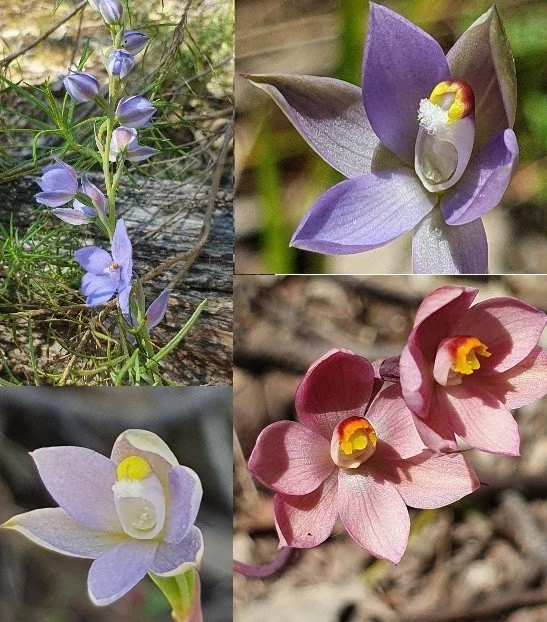
The main show must be the sun-orchids (thelymitra sp.); our day was sunny and fairly warm but early in the season for some thelymitra. Despite this we saw four species in flower, “spotted” (t. ixiodies). “forest” (t. arenaria), “salmon” (t. rubra) and “slender” (t. pauciflora). What a treat!
Our guide for the day was local ecologist Sue Ablitt to whom we offer of our sincere thanks for both her patient guidance and knowledge generously shared.
This project is supported by FRRR, through funding from the Australian Government’s Future Drought Fund.